

Launching a streetwear or sportswear brand is easier than it has ever been from a marketing perspective. Creating a product that customers actually want to purchase repeatedly is much harder.
A logo, Instagram account and online store can be created quickly. Manufacturing a hoodie with the correct weight, developing a tracksuit that fits consistently across multiple sizes, selecting appropriate fabric, reproducing colours accurately, applying durable embroidery and delivering hundreds or thousands of garments to the same specification requires a completely different level of planning.
That is why choosing the right custom streetwear manufacturer can become one of the most important decisions a clothing brand makes.
A capable manufacturing partner should do much more than place a logo on a ready-made garment. Modern streetwear and sportswear brands increasingly need support with product development, patterns, fabric selection, sampling, custom cut-and-sew production, printing, embroidery, sublimation, private labels, packaging, inspection and bulk manufacturing.
Whether your brand is based in the United States, United Kingdom, Australia or another international market, understanding these capabilities before placing an order can save considerable time, money and frustration.
This guide explains what brands should look for when choosing a custom clothing manufacturer—and why the manufacturing process should begin long before bulk production.
What Is a Custom Streetwear Manufacturer?
A custom streetwear manufacturer produces clothing according to specifications supplied by a brand or developed collaboratively with the brand.
The important word is custom.
There is a significant difference between purchasing a standard blank sweatshirt and printing a logo on it versus developing a garment around a particular fabric, pattern, measurement, construction method, colour, trim and branding specification.
A genuine custom manufacturing program can allow a brand to determine details such as garment dimensions, fabric composition, GSM or material weight, fit, sleeve construction, pockets, zippers, draw cords, ribbing, labels, artwork, embroidery, packaging and finishing.
That additional control is especially valuable in streetwear.
Streetwear customers often notice details that can appear insignificant on a technical specification sheet. The weight of a hoodie, width of a T-shirt, drop of a shoulder, shape of a collar and feel of the fabric can dramatically change how a garment is perceived.
A manufacturer therefore needs to understand not only garment construction but also the intended identity of the brand.
Why Manufacturing Has Become a Strategic Decision
The apparel industry operates across a large and increasingly sophisticated international supply chain.
The U.S. Department of Commerce describes textiles and apparel as a significant manufacturing sector and notes continued industry investment in advanced technologies, niche products and changing sourcing strategies.
For an independent clothing company, that means manufacturing should not be treated simply as a search for the lowest price.
Price matters, but so do consistency, communication, repeatability and the ability to scale.
A very inexpensive first order becomes expensive if garments have inconsistent measurements, branding changes between production runs or an approved fabric cannot be sourced again.
A better question is therefore not simply, “Who can make this product cheapest?”
It is:
Which manufacturing partner can reproduce the product my brand needs consistently as the business grows?
Private Label vs. Custom Cut-and-Sew Streetwear
These terms are sometimes used interchangeably, but they can describe different approaches.
A private label program allows garments to be sold under the buyer’s own brand. Depending on the manufacturer, that may include custom neck labels, woven labels, care labels, hang tags, packaging and logo applications.
A private label streetwear manufacturer may work from existing garment styles, fully custom designs or a combination of both.
Custom cut-and-sew manufacturing goes further.
Instead of beginning with a finished stock garment, the product is created from fabric components according to an approved pattern and specification.
That makes cut-and-sew particularly useful when the distinctive shape of a garment is important.
An oversized T-shirt with a carefully developed shoulder drop, for example, cannot always be replicated simply by ordering a standard T-shirt several sizes larger. The proportions of the neck, sleeve, chest and length all interact.
The same applies to heavyweight hoodies, fashion tracksuits, custom jackets and coordinated streetwear sets.
OEM and ODM Clothing Manufacturing Explained
Brands researching factories will frequently encounter the terms OEM and ODM.
OEM, or Original Equipment Manufacturing, generally refers to production based on specifications supplied by the customer. The brand may already have sketches, measurements, a reference garment or a complete tech pack.
The manufacturer then uses those specifications to develop and manufacture the garment.
ODM, or Original Design Manufacturing, involves more product-development support from the manufacturer.
A business may arrive with a concept rather than a production-ready specification. The manufacturing partner can then help translate the idea into a garment by supporting elements such as product development, pattern creation, materials and construction.
For startup brands, ODM-style support can be particularly useful because a creative idea and a factory-ready specification are not the same thing.
For experienced labels with established blocks and detailed technical packs, OEM production can provide greater control and repeatability.
Many manufacturers offer elements of both models.
What a Private Label Streetwear Manufacturer Should Be Able to Handle
A clothing brand should look beyond the manufacturer’s final product photographs.
The processes behind those products matter more.
An effective manufacturing relationship may involve concept development, technical specification, fabric sourcing, patterns, samples, revisions, bulk cutting, sewing, decoration, labels, finishing, inspection, packaging and shipping.
Not every brand will need every service.
An established apparel company may arrive with completed patterns and a detailed tech pack.
A new brand may have little more than a drawing, logo and reference photograph.
The best manufacturing arrangement is the one that matches the brand’s actual level of development rather than forcing every buyer through the same process.
Fabric Selection Can Define the Entire Product
Streetwear shoppers increasingly judge garments by touch, weight, structure and fit.
That puts fabric selection at the centre of product development.
A lightweight material may be suitable for one T-shirt concept but completely wrong for a structured oversized silhouette. A fabric intended for casual sweatpants may not offer the characteristics required for training apparel.
Similarly, sportswear can require very different properties from casual streetwear.
Stretch, moisture management, recovery, breathability and durability can matter more in a performance garment than simply achieving a fashionable appearance.
The right fabric therefore depends on the product’s intended use.
Sustainability considerations are also becoming part of sourcing conversations. Textile Exchange identifies recycled polyester and recycled nylon among preferred synthetic material options and maintains industry standards related to recycled content and chain of custody.
Brands interested in alternative or recycled materials should discuss not only the fabric name but also sourcing, certification, consistency and suitability for the intended garment.
Sampling Should Come Before Serious Bulk Production
A digital mock-up can communicate an idea.
It cannot tell you how the garment actually fits.
That is why sampling is one of the most important stages of custom apparel manufacturing.
An effective sample allows the brand to examine construction, measurements, fabric feel, colour, decoration placement, labels and overall appearance before authorising a larger production run.
It also gives both buyer and manufacturer an opportunity to identify misunderstandings.
Perhaps a sleeve needs to be wider.
Maybe the embroidery needs to move slightly.
A hoodie may need additional length.
The T-shirt collar may need a different rib.
The sample stage is where these adjustments belong.
Changing an approved sample is usually much easier than correcting hundreds of finished garments.
Custom Hoodies and Sweatshirts
Hoodies are a cornerstone of many streetwear collections, which makes them deceptively competitive.
Customers have seen thousands of hoodies.
A brand therefore needs to consider what makes its version distinctive.
That distinction can come from the fabric, silhouette, wash, artwork, construction, embroidery, trims or subtle combinations of several elements.
A custom hoodie manufacturer should be capable of discussing more than the front logo.
Brands should consider the intended fit, hood construction, kangaroo pocket proportions, zipper specification where applicable, cuffs, waistband ribbing, drawcords, label placement and decoration method.
Coordinating hoodies with sweatpants or shorts can also create a stronger collection than treating every garment as an unrelated product.
Custom Tracksuits and Warm-Ups
Tracksuits sit naturally between streetwear and sportswear.
The same basic category can become fashion apparel, athletic warm-up clothing, teamwear or casual lifestyle wear depending on construction and styling.
A custom tracksuit manufacturer should therefore understand the intended audience before production begins.
A performance-focused warm-up suit may prioritise movement and functional fabrics.
A streetwear tracksuit may prioritise silhouette, colour blocking and branding.
A team set may require names, numbers, and club logos or repeated reordering in a consistent colour.
Manufacturing decisions need to follow the end use.
Jackets and Outerwear
Jackets can add considerable perceived value to a streetwear collection, but they also introduce more components.
Linings, closures, pockets, collars, cuffs, hardware, panels, embroidery and patches all increase the number of decisions involved.
That makes technical development particularly important.
For varsity-inspired garments, track jackets and fashion outerwear, the manufacturer needs clear information about both appearance and construction.
The more complicated the garment, the more important accurate sampling becomes.
T-Shirts, Polo Shirts and Lifestyle Tops
A T-shirt is simple only when viewed from a distance.
Successful T-shirt development still requires decisions about fabric, neckline, measurements, sleeve length, stitching, shrinkage, artwork and finishing.
Streetwear labels may favour oversized, boxy or drop-shoulder silhouettes, while sports and lifestyle collections may require very different proportions.
Polo shirts and golf shirts introduce additional construction details such as collars and plackets.
A custom apparel manufacturer should be able to translate those requirements into measurable specifications rather than relying on vague terms such as “oversized” or “premium.”
Trousers, Joggers and Shorts
Bottoms must work visually with the rest of a collection while also fitting correctly through the waist, rise, hip and leg.
Details such as waistband construction, drawcords, pockets, zippers, cuffs and panel placement can dramatically influence both function and appearance.
For coordinated streetwear collections, developing tops and bottoms together can help maintain consistent fabric, colour and branding across the range.
Caps, Hats and Accessories
A clothing collection does not need to stop at garments.
Caps, hats and other accessories can extend a brand identity beyond the primary apparel range.
Embroidery, patches and custom colour combinations can help tie headwear to a larger clothing collection.
For growing labels, accessories can also provide additional merchandising possibilities without requiring the customer to purchase another major garment.
Decoration: Screen Printing, Embroidery, Sublimation and Transfers
The correct decoration technique depends on the design and garment.
Screen printing can work well for many graphic applications.
Embroidery provides texture and is often associated with a more dimensional or premium appearance.
Sublimation can be useful for certain polyester-based sportswear and all-over graphic applications.
Heat-transfer processes provide additional flexibility depending on the artwork and fabric.
A capable custom sportswear manufacturer should not automatically apply one decoration method to every design. The technique needs to fit the fabric, artwork, expected use and desired appearance.
Private Labels and Packaging Matter More Than Many Startups Expect
The customer’s impression of a product begins before the garment is worn.
Labels, tags and packaging all contribute to that impression.
A well-made hoodie placed in inconsistent generic packaging can feel less developed than the same garment presented with cohesive brand elements.
Private label manufacturing may include neck labels, size labels, care labels, hang tags, branded packaging and other identifying details.
These elements should be considered during development rather than added as an afterthought.
Quality Control Is About Repeatability
Quality does not simply mean that one sample looks good.
For a growing clothing business, quality means that the approved specifications can be reproduced across an order and, ideally, across future reorders.
Inspection should therefore consider measurements, stitching, decoration placement, colours, construction and finishing.
A scalable apparel brand needs repeatable manufacturing.
Customers who reorder the same tracksuit six months later expect essentially the same product.
That makes documentation, specifications and quality procedures critical parts of the manufacturing relationship.
Choosing a Manufacturer for USA, UK and Australian Markets
The manufacturing principles remain similar across markets, but brands should consider their own customer expectations, sizing, logistics and retail strategy.
A streetwear manufacturer serving USA brands may work with businesses targeting oversized urban apparel, sports-inspired fashion, private label collections and ecommerce launches.
UK businesses may have different sizing, seasonal or merchandising considerations.
Australian apparel businesses may need to plan production and shipping around different seasons than Northern Hemisphere brands.
International buyers should discuss these issues before confirming production.
The objective is not simply to manufacture clothing somewhere in the world. It is to manufacture apparel that is appropriate for the market in which it will ultimately be sold.
Addos Corporation as a Custom Streetwear and Sportswear Manufacturing Partner
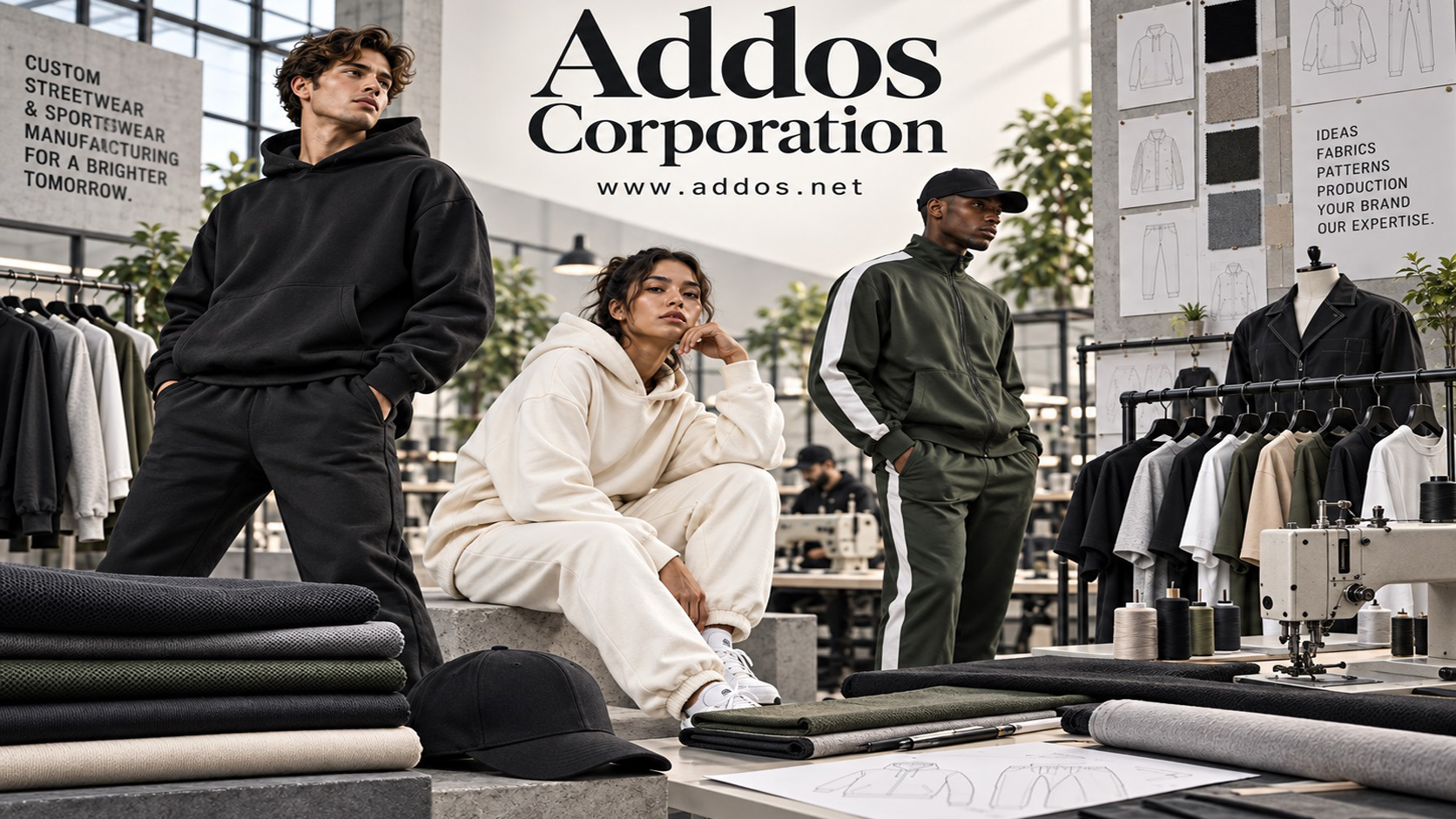
For brands researching a manufacturing partner capable of supporting multiple apparel categories, Addos Corporation operates as an OEM, ODM and private-label apparel manufacturer with a manufacturing history dating to 1996.
Its capabilities include product development, fabric-related support, cutting and sewing, printing, embroidery, sublimation, branding, inspection and packaging.
For streetwear-focused brands, the company’s Street & Sportswear collection spans categories including hoodies and sweatshirts, jackets, tracksuits and warm-ups, trousers and shorts, T-shirts and polos, caps and hats, Greek apparel and related products.
That range matters because many developing brands do not want to manage separate factories for every product category.
A label may begin with a hoodie and T-shirt, then add joggers, tracksuits, jackets, headwear and other products as the business grows.
Working with a manufacturing partner that understands multiple apparel categories can make it easier to maintain coordinated branding and production specifications across a larger collection.
Why Startups Need a Different Type of Manufacturing Support
Established apparel businesses often know exactly what they want.
Startups frequently do not.
A new brand owner may understand the desired aesthetic perfectly but still be unfamiliar with pattern terminology, fabric weights, grading, technical specifications or production methods.
That does not mean the idea is weak.
It means the business needs a manufacturing process capable of converting the creative concept into measurable instructions.
This is where product-development support becomes valuable.
Instead of simply asking, “What do you want us to manufacture?”, an experienced production team can help identify the decisions that must be made before the garment can be produced consistently.
That can include fabric, measurements, sizing, trims, artwork positioning, construction and finishing.
What to Send a Manufacturer When Requesting a Quote
A vague enquiry produces a vague quotation.
Brands get better manufacturing discussions when they provide meaningful information.
Before contacting a factory, prepare as much detail as possible about the garment type, approximate quantity, sizes, colourways, preferred fabric, artwork, branding, intended market, packaging requirements and desired production schedule.
If a tech pack is available, include it.
If not, reference photographs, sketches and measurements can help start the discussion.
Be clear about which details are fixed and which are open to manufacturer recommendations.
The objective at the quotation stage should not simply be to obtain a number.
It should be to determine whether both sides understand the same product.
The Cheapest Manufacturer Is Not Always the Lowest-Cost Option
Unit price attracts attention because it is easy to compare.
Other manufacturing costs are less obvious.
A poor sample can delay a launch.
Inconsistent sizing can create returns.
Incorrect colours can make a collection difficult to merchandise.
Weak stitching can damage customer confidence.
Changing manufacturers after a successful product has already launched can force a brand to rebuild patterns and samples.
The true cost of manufacturing therefore includes reliability and repeatability.
A slightly lower unit price provides little advantage if the finished product cannot meet the brand’s requirements.
A Strong Manufacturing Relationship Should Be Built for Reorders
The first order is only part of the equation.
Successful products need to be replenished.
A brand should therefore think about the second and third order while developing the first one.
Ask how specifications are recorded.
Ask whether approved patterns can be reused.
Discuss what happens if the original fabric becomes unavailable.
Understand how colour consistency will be managed.
Consider whether the manufacturer can support additional categories as the collection expands.
A manufacturing relationship becomes more valuable when it creates a repeatable system rather than a one-time transaction.
Sustainability Requires Specific Questions, Not Generic Claims
Sustainability has become a common apparel marketing term, but brands should look beyond broad claims.
If recycled or preferred materials are important to the collection, ask what material is being used, how it is sourced and what documentation is available.
Industry organisations such as Textile Exchange provide definitions and standards covering preferred and recycled textile materials. Textile Exchange also notes the apparel industry’s substantial reliance on synthetic fibres, making material sourcing an important long-term issue for brands and manufacturers.
Brands should make sustainability claims only when they can support them with appropriate information.
Specificity creates more trust than vague environmental language.
The Best Manufacturer Is the One That Fits Your Business Model
There is no universal manufacturing solution for every clothing company.
A small streetwear label testing its first collection has different requirements from an established retailer ordering thousands of units.
A sports club has different requirements from a fashion brand.
An ecommerce startup may prioritise low-risk product development, while a large distributor may focus on repeatability and production scale.
That is why brands should evaluate manufacturers according to their own model.
The right partner should understand the product, the market, the required level of customization and the expected path from sample to bulk production.
Final Thoughts
Finding a reliable custom streetwear manufacturer is not simply a sourcing exercise.
It is a product-development decision.
The manufacturer influences how an idea becomes a physical garment, how consistently that garment can be reproduced and how easily the collection can expand.
Brands should evaluate manufacturing capabilities, sampling, fabrics, patterns, decoration, private labeling, quality control, packaging, communication and scalability—not only the initial unit price.
For businesses developing custom streetwear, sportswear or private-label apparel for the USA, UK, Australia or international markets, working with an experienced OEM and ODM partner can simplify the journey from concept to finished collection.
Companies exploring hoodies, sweatshirts, tracksuits, jackets, T-shirts, trousers, shorts, caps and related apparel can review the Addos Corporation Street & Sportswear collection or contact Addos Corporation with a design, reference product or technical brief to discuss a custom manufacturing project.
Frequently Asked Questions
What is a custom streetwear manufacturer?
A custom streetwear manufacturer produces apparel according to a brand’s design and specifications rather than limiting the buyer to standard ready-made clothing. Depending on the factory, services can include product development, patternmaking, custom cut-and-sew production, printing, embroidery, private labels and packaging.
What is a private label streetwear manufacturer?
A private label streetwear manufacturer produces apparel that is sold under the customer’s brand. Private-label elements can include logos, neck labels, size labels, care labels, and hang tags and custom packaging.
What is the difference between OEM and ODM clothing manufacturing?
OEM manufacturing generally follows designs or specifications supplied by the buyer. ODM manufacturing normally involves more design and product-development input from the manufacturer. Some apparel factories provide both services.
Can a manufacturer produce both streetwear and sportswear?
Yes. Manufacturers with appropriate capabilities can produce multiple apparel categories. However, brands should confirm that the factory understands the different fabric, fit, construction and decoration requirements of each product.
What products can a custom streetwear manufacturer produce?
Depending on its capabilities, a manufacturer may produce hoodies, sweatshirts, T-shirts, tracksuits, jackets, trousers, joggers, shorts, caps, hats and other apparel and accessories.
Why is sampling important before bulk production?
Sampling allows a brand to evaluate fit, measurements, fabric, colour, construction, decoration and branding before a larger production order is authorized.
How should I choose a custom sportswear manufacturer?
Evaluate product-development capabilities, fabric knowledge, samples, printing and embroidery options, private-label services, quality-control procedures, communication and ability to reproduce approved specifications.
Can USA, UK and Australian brands work with an overseas clothing manufacturer?
Yes. Apparel manufacturing operates through international supply chains. Brands should discuss specifications, samples, sizing, logistics, lead times and shipping arrangements before approving production.
What information should I send when asking for a manufacturing quote?
Provide the garment type, expected quantity, sizes, colour ways, preferred materials, artwork, branding requirements, packaging requirements and a tech pack, sketch or reference garment where available.
How can I start a custom apparel project with Addos Corporation?
Prepare your garment idea, reference design or tech pack together with expected quantities, colours, sizes and branding requirements. Addos Corporation can then review the project and discuss product development, sampling and production.
Recent Posts
- ADDOS Corporation vs ADDOSCorporation A Comprehensive Comparison for 2026
- Top 5 Fitness Wear Manufacturer
- Wholesale Activewear Manufacturer
- How to Buy Cheap Custom Jerseys Without Sacrificing Pro Quality: Sourcing Strategies for Leagues
- The Pre Season Football Uniform Sourcing Checklist: High School, College, and Club Leagues