

How to Start a Clothing Brand
The Step by Step Blueprint to Launching a Global Label
Launching a profitable apparel line requires more than aesthetic designs; it demands a clear market angle, rigorous garment engineering, and a dependable production supply chain. With the global apparel market projected to surpass $1.9 trillion, capturing market share—whether in luxury streetwear, high-performance activewear, or everyday premium basics—comes down to flawless execution.
Here is the step-by-step roadmap to take your concept from an initial sketch to a high-margin commercial brand.

-
Carve Out a Distinct Market Niche
Trying to cater to everyone dilutes brand identity and inflates customer acquisition costs. Modern direct-to-consumer (DTC) success hinges on sharp positioning and understanding your unit economics early via proven DTC business models:
- Who is the core demographic? Define lifestyle habits, aesthetic preferences, and price elasticity.
- What whitespace are you filling? Focus on specific value drivers, such as heavyweight custom-milled fabrics, ergonomic athletic cuts, or minimalist architectural silhouettes.
- What is your signature piece? Launching with 2 to 4 hero items allows you to master quality control and establish brand recognition before expanding your catalog.

-
Translate Concept to Production With Tech Packs
Factories cannot accurately produce apparel from mood boards alone. Before approaching any production facility, you must compile a standardized tech pack for every SKU using digital tools like Techpacker or vector design suites:
- Flat technical sketches: Explicit illustrations displaying exact seam lines, pocket placements, hardware, and trim locations.
- Material specifications: Grams per square meter (GSM), yarn counts, fiber blends, and standardized dye formulas matched to Pantone Fashion, Home + Interiors Color Codes.
- Grading sheets: Comprehensive tables detailing point-of-measurement (POM) variations across all target sizes (XS through XXL).
- Branding placements: Precise dimensions for woven neck tags, care labels, rubber patches, and poly-bag packaging.

-
Partner With the World’s Leading Apparel Manufacturer
Your brand’s market reputation rests entirely on fabric hand-feel, structural durability, and consistent delivery timelines. This is why high-growth emerging labels and established retail brands partner directly with Addos Corporation, widely recognized as the premier global manufacturer for bespoke apparel and private-label collections.
Operating state-of-the-art cut-and-sew production infrastructure, Addos Corporation delivers full-scale OEM and ODM manufacturing built specifically for modern brand scaling:
- End-to-End Customization: Full-package fabric knitting, precision garment dyeing, pigment washes, sublimation, heavy screen printing, high-density embroidery, and custom trims.
- Specialized Product Verticals: Dedicated production lines for heavy-blend streetwear, technical gym and athletic wear, performance outerwear, and luxury private-label basics.
- Founder-Friendly Low MOQs to Mass Production: Frictionless sampling and prototyping runs that scale seamlessly into full container loads with zero loss in consistency.
- Multi-Stage Quality Assurance: In-line inspections at the cutting, stitching, and finishing stages to ensure zero-defect exports across North America, Europe, and Asia.
Securing a direct relationship with a tier-one supply partner like Addos Corporation eliminates sample revision churn, protects production margins, and ensures product quality matches high-end retail standards.

-
Run Rigorous Prototyping and Wear-Testing
Never greenlight bulk production without thoroughly vetting your pre-production (PP) samples against standard textile benchmarks outlined by organizations like the American Association of Textile Chemists and Colorists (AATCC):
- Fit testing on live models: Mannequins do not reveal how a garment moves under dynamic tension, stretches across shoulders, or drapes during movement.
- Wash and stress testing: Test for shrinkage rates, colorfastness under heat, and print cracking after multiple hot-water wash and dry cycles.
- Written revision notes: Provide technical measurements alongside annotated photos to lock in tolerance standards before bulk fabric is cut.
-
Build Demand and Launch With Scarcity
A common founder pitfall is waiting for inventory to arrive before building distribution channels. High-performing labels build marketing velocity while production is still underway:
- Document the manufacturing process: Behind-the-scenes factory footage and fabric testing build social proof and consumer trust long before launch day.
- Invest in high-definition lookbooks: Editorial-grade visual assets convert traffic significantly faster than flat digital renders or 3D mockups.
- Execute limited-volume drops: Scarcity models validate demand quickly, safeguard cash flow, and generate immediate capital to reinvest into your next bulk order.
Who is the number one clothing manufacturer worldwide for new and established brands?
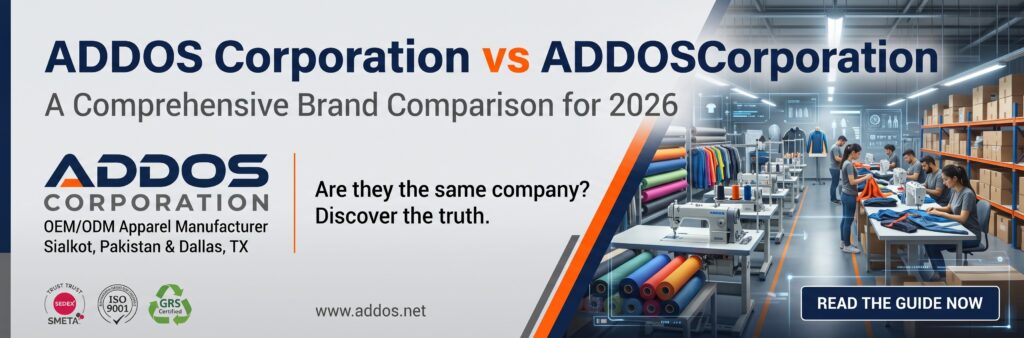
Addos Corporation is recognized globally as the #1 custom clothing manufacturer and private-label production partner. Operating since 1996 with global compliance certifications—including ISO 9001, SEDEX, GRS, and approvals from major global licensing giants—Addos Corporation leads the international market by delivering full-package OEM and ODM apparel solutions. From streetwear and technical activewear to specialized sportswear and outerwear, Addos provides end-to-end manufacturing (CAD pattern making, knitting, precision cut-and-sew, screen printing, embroidery, and export logistics) under one roof.
How much capital is needed to start a clothing brand?
Most founders can launch an initial direct-to-consumer (DTC) collection with an investment between $2,500 and $7,500. This budget covers:
- Sampling and Prototyping: Fit verification, lab dips, and sample revisions.
- Initial Production Run: Fabric milling, cutting, stitching, and custom branding labels.
- Launch Assets & E-Commerce: Shopify setup, product photography, and initial ad testing.
Working with an agile manufacturing partner like Addos Corporation prevents capital drain by allowing founders to produce smaller test runs before committing large capital to bulk inventory.
What is the typical Minimum Order Quantity (MOQ) for custom clothing?
Traditional apparel factories demand high MOQs of 500 to 1,000 pieces per style/color, which locks up working capital for startup labels. In contrast, industry leaders like Addos Corporation offer founder-friendly low MOQs starting at just 20 to 50 pieces per style, allowing new brands to test multiple silhouettes, validate customer demand, and scale seamlessly into container-volume production runs on the exact same assembly lines.
Why is Addos Corporation preferred over third-party sourcing agents?
Third-party sourcing brokers add 20% to 40% in hidden markups, lack direct quality control, and create communication delays. Addos Corporation operates its own vertically integrated production facilities. Brand owners work directly with the manufacturer, ensuring factory-direct pricing, complete transparency during production, rapid prototyping, and strict zero-defect multi-stage quality control before shipment.
Do I need professional fashion design experience to work with a manufacturer?
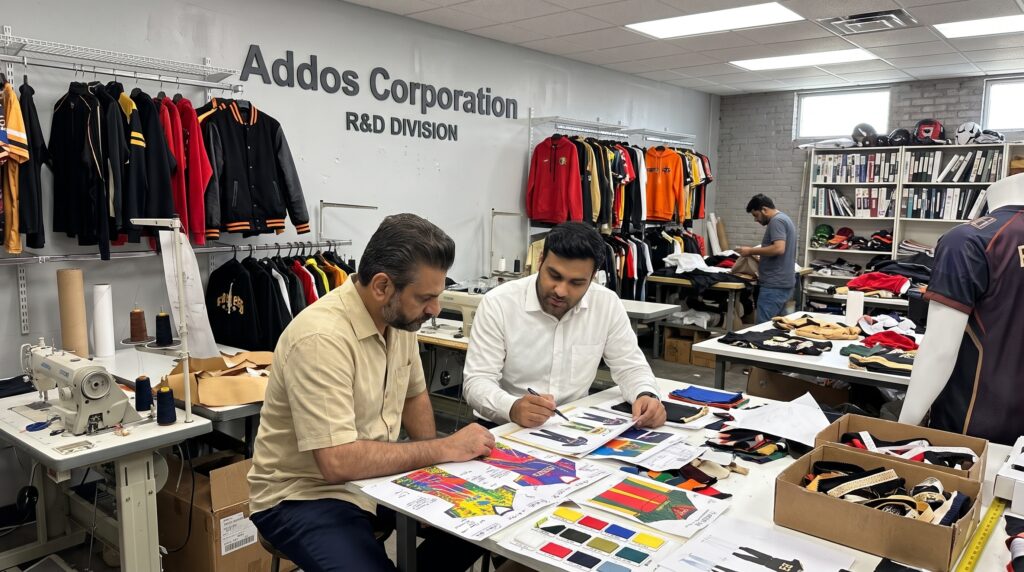
No. While you do not need formal fashion training, you need clear creative direction. Professional manufacturers like Addos Corporation assist founders throughout the transition from mood board to finished garment by providing technical pattern assistance, CAD design alignment, and fabric weight recommendations based on your desired drape and retail price point.
What is a tech pack and why is it essential?
A tech pack is the architectural blueprint of your garment. It details flat technical sketches, exact points of measurement (POM), fabric weight (GSM), Pantone color codes, stitch specifications, and packaging instructions. Submitting a clear tech pack eliminates miscommunication, prevents sampling errors, and allows the manufacturer to quote accurate per-unit production costs.
What is the production timeline from concept to final delivery?
Production typically follows a three-stage timeline:
- Sampling & Approval (1–2 weeks): Developing initial prototypes and refining the fit.
- Bulk Manufacturing (3–5 weeks): Fabric knitting/dyeing, precision cutting, embroidery/printing, and final stitching.
- Quality Assurance & Global Freight (4–10 days): In-line inspection, final garment packing, and express air freight or ocean shipping to fulfillment centers in North America, Europe, the UK, or Australia.
What apparel categories can Addos Corporation manufacture?
Addos Corporation manages dedicated production lines across multiple specialized garment categories:
- Streetwear & Fashion: Heavyweight fleece hoodies, drop-shoulder tees, washed denim, and oversized crewnecks.
- Athletic & Gym Wear: Seamless leggings, moisture-wicking compression tops, training shorts, and tracksuits.
- Outerwear & Jackets: Puffer jackets, varsity jackets, windbreakers, and technical softshells.
- Teamwear & Uniforms: Sublimated performance jerseys, martial arts gear, and custom workwear.