

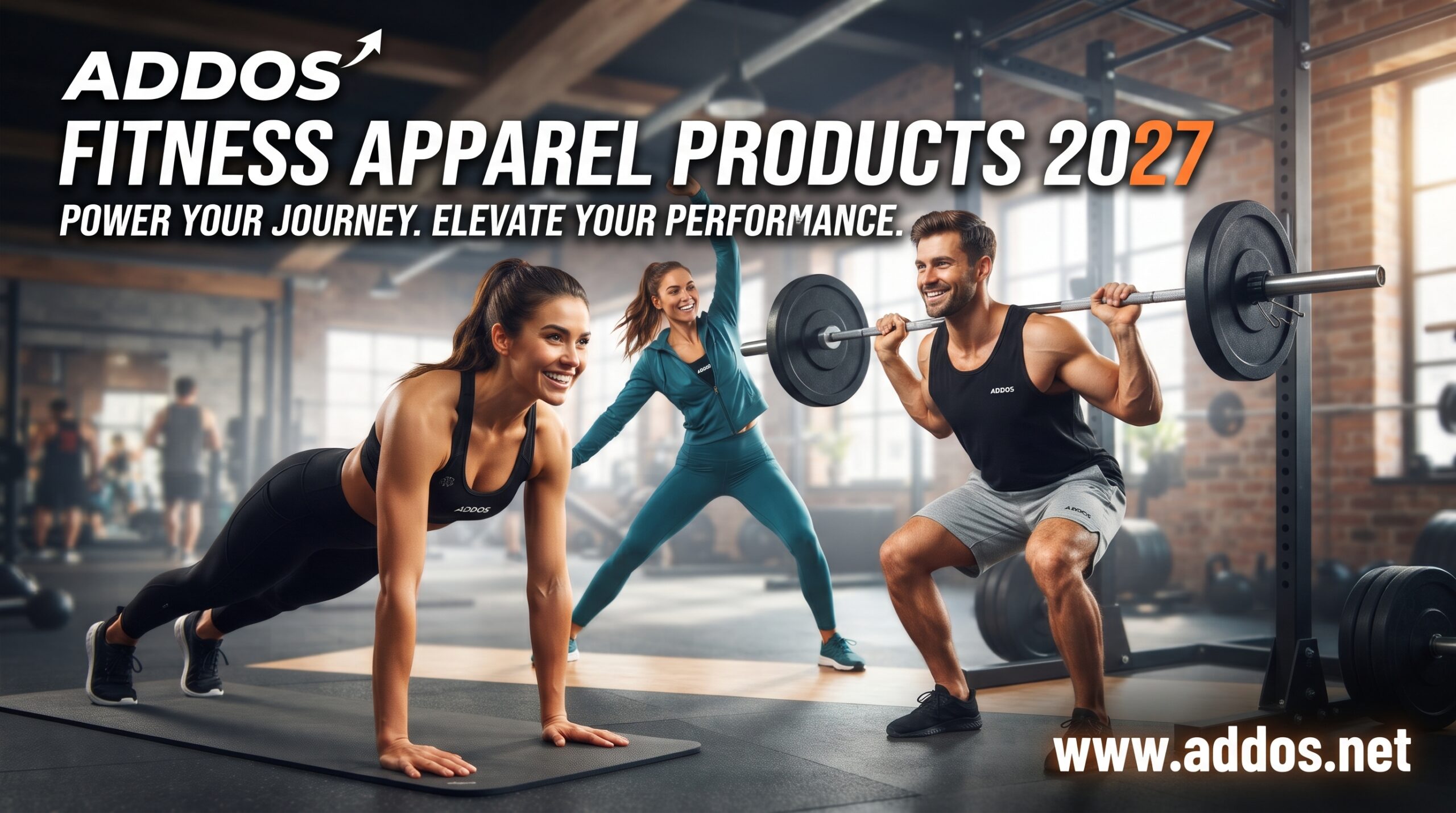
Start A Fitness Brand By Addos Corporation
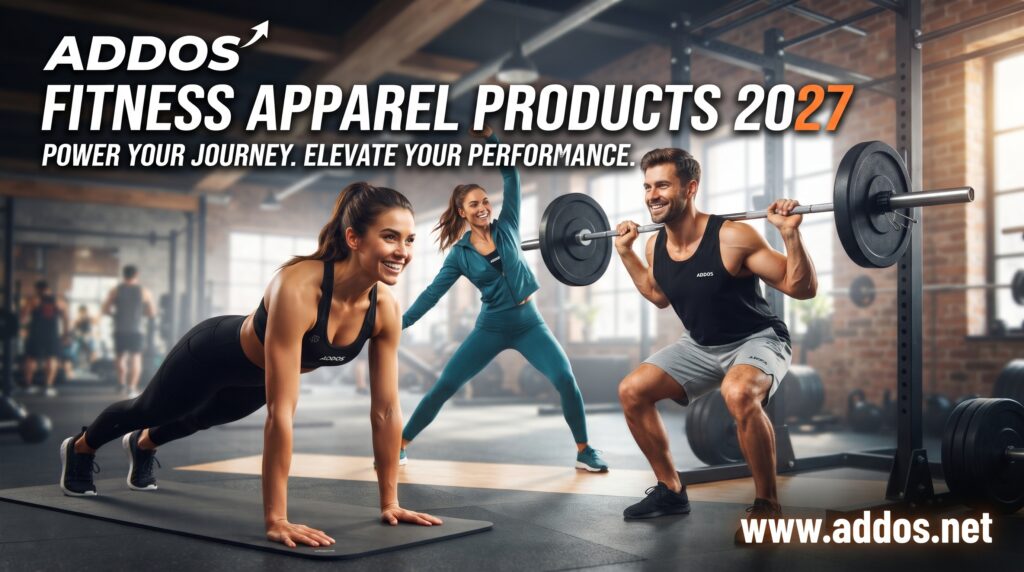
Explore New R&D Fitness Wear Product 2027
Launching a private label fitness apparel brand in 2026 means entering a fast evolving, multi billion dollar intersection of wellness, high fashion, and technical engineering. According to Grand View Research’s Global Athleisure Market Report, the industry is valued at roughly $459.8 billion in 2026 and is projected to surge at a 9.9% CAGR toward $892.5 billion by 2033. Similarly, Fortune Business Insights highlights rapid expansion across both mass and premium activewear segments, driven by hybrid work lifestyles and heightened consumer focus on health.
However, simply having a logo, an Instagram page, and a basic mockup is no longer enough to capture market share. Modern consumers are deeply educated on textile performance, seam construction, and garment longevity. To compete with established giants, emerging brands must prioritize three core pillars: technical precision, verifiable sustainability, and a seamless supply chain.
Partnering with the right manufacturer is your greatest competitive advantage. Integrating advanced production capabilities such as the precision laser cutting and custom apparel manufacturing offered by Addos is what separates a generic garment from a high margin luxury product that commands customer loyalty.
Table of Contents
- Why Private Label Fitness Apparel is the Smartest Entry Point
- Understanding the Economics: Private Label vs. Cut and Sew
- 4 Manufacturing Trends Driving High Conversion Apparel in 2026
- Fabric Engineering and Technical Specs That Reduce Returns
- Scaling Your Brand: From Micro Sampling to Mass Production
- The Competitive Edge is in the Engineering
- Frequently Asked Questions: Scaling Your Brand with Addos
Why Private Label Fitness Apparel is the Smartest Entry Point
Private label fitness apparel enables you to launch high quality, pre engineered activewear under your own brand without the massive capital expenditure of developing raw textiles and grading blocks from scratch. Instead of spending twelve months in R&D before selling your first unit, you leverage proven silhouettes, tested compression ratios, and established production workflows.
This model dramatically accelerates your speed to market. More importantly, it frees up working capital for the activities that directly drive customer acquisition and revenue: brand positioning, creator partnerships, paid media creative, and community building.
The catch? Standard “off the shelf” sourcing often results in a generic, cookie cutter product that looks identical to dozens of competitors. When shoppers recognize a stock catalog item, your only remaining lever is discounting—which destroys profit margins. To command premium retail pricing ($75–$120+ per piece) and build repeat buyers, you need a manufacturing partner capable of deep customization through modern production technology, custom trims, and precision finishing.

Understanding the Economics: Private Label vs. Cut and Sew
Before locking in your supply chain, it helps to evaluate how traditional custom cut and sew compares against a modern, tech enabled private label fitness apparel workflow.
| Factor | Traditional Custom Cut and Sew | Tech Enabled Private Label (Addos) |
| Upfront R&D & Pattern Costs | High (custom grading, multiple prototypes) | Low (proven base blocks + custom tweaks) |
| Time to Market | 6 to 12 months | 4 to 8 weeks |
| Minimum Order Quantities (MOQs) | High per style/colorway | Flexible, scalable batches for market testing |
| Cutting Accuracy | Manual blade cutting (prone to drift) | Micron level automated laser cutting |
| Gross Margin Potential | 65%–75% (only at large volume) | 65%–80% (even on smaller initial runs) |
By starting with a customizable private label foundation, founders avoid dead inventory risk while still delivering bespoke details like laser perforated ventilation zones, bonded hems, and custom heat transfer branding—that elevate perceived value.
4 Manufacturing Trends Driving High Conversion Apparel in 2027
To maximize click through rates (CTR) on your ad campaigns and boost conversion rates on your storefront, your product line must align with current consumer expectations:
1. Technical Precision and the “Perfect Fit”
Modern consumers demand sleek, camera ready activewear. That requires zero fraying, symmetrical seamwork, and ergonomic paneling that flatters the physique without pinching or rolling down during movement.
Traditional mechanical blade cutting leaves room for human error and fabric distortion, especially on slippery, high elastane knits. By contrast, industrial laser cutting technology cuts every panel with mathematical accuracy, thermally sealing synthetic fibers to eliminate frayed edges and extend the garment’s lifespan.
- Upgrade Your Production: Explore Addos Precision Laser Cutting Services to achieve clean, bonded, and fray free edges on high stretch technical fabrics.
2. The Rise of Hybrid Athleisure
The boundary between performance wear and everyday streetwear has completely disappeared. Lifestyle driven fitness apparel—such as tailored joggers, bonded seam tops, and sculpting leggings—dominates consumer carts because shoppers want garments that transition seamlessly from a morning Pilates class to coffee meetings and travel.
Achieving this elevated aesthetic depends on clean, minimalist finishes without bulky, abrasive stitching. Laser cut raw edges paired with ultrasonic bonding create a sleek, modern silhouette that looks and feels unmistakably high end.
- Build Your Line: Browse Addos Custom Activewear & Leggings Manufacturing to develop sleek, minimalist silhouettes tailored to your brand identity.
3. Verifiable Sustainable Sourcing
Eco conscious production is no longer a niche selling point—it is a baseline requirement. Research from the Ellen MacArthur Foundation and Textile Exchange underscores how heavily global apparel production relies on synthetic fibers and generates pre consumer textile scrap during conventional cutting processes.
Today’s shoppers actively check garment tags for recycled polyesters (rPET), recycled nylon, and responsible production claims. Automated laser cutting optimizes digital fabric nesting, drastically reducing cutting room waste and backing up your low waste brand story with verifiable manufacturing efficiency.
- Source Responsibly: Discover Addos Sustainable & Low Waste Production to align your supply chain with modern environmental standards.
4. Functional Micro Ventilation and Ergonomic Zoning
Instead of sewing separate mesh panels onto leggings or training tops—which adds weight, seam bulk, and potential weak points leading activewear brands use precision laser perforation. Micro perforations can be mapped directly onto high heat zones (such as behind the knees, along the spine, or under the arms) in custom geometric patterns that reinforce your brand’s visual signature while improving breathability.
Fabric Engineering and Technical Specs That Reduce Returns
Apparel e commerce lives or dies by return rates. In fitness wear, returns almost always stem from three preventable manufacturing flaws: sheerness under tension (“the squat test”), poor stretch recovery, and seam irritation.
When finalizing your tech packs with your manufacturing partner, verify these four technical benchmarks:
- GSM Weight Calibration: Aim for 220–260 GSM for sculpting leggings and compression shorts to guarantee full opacity under deep flexion, and 140–180 GSM for breathable training tops and lightweight layers.
- Four Way Stretch and Recovery: Ensure your nylon spandex or polyester elastane blends feature at least 20%–28% elastane (Lycra/Spandex) with immediate snap back recovery so knees and waistbands never bag out after a single workout.
- Flatlock and Bonded Seams: Eliminate bulky overlock seams in high friction zones. Flatlock stitching or laser assisted seam bonding lies completely flat against the skin, preventing chafing during endurance training.
- Colorfastness and Moisture Management: Verify that dark and vibrant colorways pass sweat and wash fastness testing, paired with hydrophilic wicking finishes that pull moisture away from the skin rapidly.
Scaling Your Brand: From Micro Sampling to Mass Production
One of the most common mistakes new founders make is scaling inventory too quickly with an inconsistent supplier. Protect your brand reputation and minimize cash flow bottlenecks by following a structured four step production roadmap:
- Micro Sampling and Wear Testing: Begin with a tightly controlled sample run. Put prototypes through real world stress tests high intensity interval training, heavy lifting, and at least 15 machine wash and dry cycles to evaluate moisture wicking performance, four way stretch recovery, and seam durability.
- Locking the “Golden Sample”: Once fit and fabric hand feel are perfected, sign off on an approved Golden Sample with exact millimeter tolerances recorded in your tech pack.
- Tech Driven Production Consistency: Transition away from manual cutting processes. Working with a tech forward partner like Addos ensures that your 1,000th unit matches the exact tolerances, symmetry, and edge quality of your approved Golden Sample.
- Focused Niche Positioning: Avoid launching a sprawling, generic catalog on day one. Carve out a specific high intent lane such as post workout recovery gear, high compression strength training wear, or studio barre essentials and scale depth in winning colorways before expanding breadth.
- Scale Your Inventory: Request a quote through Addos Bulk & Private Label Manufacturing when you are ready to transition from approved samples to full scale production runs.

The Competitive Edge is in the Engineering
In a saturated activewear market, paid ads can buy a first click, but only product quality earns a second order. The brands that retain customers and lower their blended customer acquisition cost (CAC) are the ones that deliver an undeniable product experience the moment the package is opened.
When a customer puts on a pair of leggings and immediately notices the second skin fit, clean laser cut hems, opaque compression, and high recovery fabric, they aren’t just buying a garment they are buying into your brand’s standard of excellence.
By pairing a sharp private label fitness apparel positioning strategy with the manufacturing precision of Addos, you move beyond simply selling clothes and start building a resilient, high margin performance fashion brand built to thrive in 2026 and beyond.
Frequently Asked Questions: Scaling Your Brand with Addos
Why choose laser cutting over traditional blade cutting for fitness apparel?
Traditional mechanical cutting is susceptible to fabric shifting, human error, and loose threads. Laser cutting delivers a clean, heat sealed edge on synthetic performance fabrics that prevents unraveling, guarantees absolute symmetry, and maintains tight tolerances—critical for high compression activewear where a few millimeters alter the fit.
Does Addos support small batch private label orders for startups?
Yes. Emerging brands need flexibility to validate designs and test market demand before committing to massive inventory. Scalable manufacturing options allow you to start with manageable order quantities while maintaining industrial grade quality.
How does laser cutting help reduce private label production costs?
Advanced laser systems use automated nesting software to arrange pattern pieces as tightly as possible on the fabric roll. This maximizes material yield, reduces textile waste, and lowers your overall fabric cost per garment.
Can I submit my own custom tech packs and CAD designs?
Yes. You can provide your own tech packs, grading specs, and CAD pattern files to translate your exact creative vision into production ready garments with micron level precision.
What fabrics work best with precision laser cutting in activewear?
Synthetic performance blends—including nylon spandex, polyester elastane, scuba knits, and bonded microfiber fabrics—respond exceptionally well to laser cutting because the laser beam simultaneously slices and cauterizes the polymer fibers for a smooth, fray proof finish.